
Product image
Espresso Machines
DeLonghi La Specialista Arte Evo Review
A stylish all-in-one espresso maker with a competent grinder and a price that undercuts Breville. But how does it stack up where it matters?
"We tested 12 sets to find out what's truly safe, durable, and worth your money."
Finding truly non-toxic cookware can be a maze of marketing jargon. After rigorous testing, we’ve cut through the greenwashing to find the safest, highest-performing ceramic, stainless steel, and cast iron sets that actually belong in your kitchen.
Top picks: Caraway Ceramic, All-Clad Stainless, and Lodge Cast Iron
If you want the ultimate safe and durable cooking experience, invest in a high-quality stainless steel set like the All-Clad D5. For those who need non-stick convenience, the Caraway ceramic set is our top non-toxic choice for 2026.
For decades, traditional non-stick pans dominated home kitchens. The convenience was undeniable, but the environmental and health costs were largely hidden. The primary culprit was PFOA (perfluorooctanoic acid), a chemical historically used to manufacture PTFE (polytetrafluoroethylene), commonly known by the brand name Teflon.
While PFOA has been largely phased out of cookware manufacturing in the US and Europe, the term "non-toxic" has become a marketing buzzword. Many modern PTFE pans are marketed as "PFOA-free," but they still rely on related "forever chemicals" (PFAS) to achieve their slippery surface. When heated past 500°F (260°C), PTFE coatings can degrade, releasing fumes that can cause flu-like symptoms in humans (known as polymer fume fever) and are famously lethal to pet birds.
True non-toxic cookware goes beyond "PFOA-free." It means relying on materials that don't leach harmful chemicals into your food or the air, even at high temperatures. The three gold standards for non-toxic cooking are ceramic-coated aluminum, fully clad stainless steel, and bare cast iron or carbon steel.
"The term 'non-toxic' isn't heavily regulated. As consumers, we have to look past the green packaging and understand the actual materials used in the pan's construction."
Ceramic cookware is currently the darling of the non-toxic movement, and Caraway has largely led the charge. The term "ceramic" here is slightly misleading; these pans are typically an aluminum or steel core coated with a sol-gel (solution-gelation) layer derived from silica (sand). This creates a slick, non-stick surface without the use of PFAS or PTFE.
In our month-long testing of the Caraway Home Set, it performed beautifully. Eggs slid out without a spatula, and caramelized onions wiped clean with just a paper towel. The thermal conductivity of the aluminum core provided even heating across the entire pan surface.
However, ceramic coatings require more care than traditional Teflon. You must use low to medium heat, avoid metal utensils entirely, and hand-wash them. Over time (typically 1-3 years depending on use), the non-stick properties will begin to fade. But for the health-conscious cook who insists on the convenience of a slick surface, Caraway remains our top recommendation.
| Brand | Caraway |
| Material | Aluminum core with mineral-based ceramic coating |
| PFAS/PTFE Free? | Yes, 100% |
| Oven Safe | Up to 550°F |
| Price | ~$395 (Set) |
Beautiful, PFAS-free, and incredibly slick. Includes clever storage solutions.
If you want cookware that will last a lifetime without degrading, stainless steel is the undisputed king. It is fundamentally inert, meaning it won't react with acidic foods (like tomatoes or wine) and won't leach anything into your meal, regardless of how hot it gets.
The All-Clad D5 set features five alternating layers of stainless steel and aluminum. The stainless exterior and interior provide durability and safety, while the internal aluminum layers conduct heat quickly and evenly. In our sear tests, the All-Clad D5 produced the most consistently beautiful crust on steaks without any warping.
The learning curve for stainless steel is real. You have to preheat the pan properly (using the "water drop" test) and use adequate fat to prevent sticking. But once you master temperature control, stainless steel becomes incredibly versatile. It can go from stovetop to a 600°F oven to the dishwasher.
"Stainless steel is an investment in generations. You buy an All-Clad set once, and your grandchildren will likely inherit it."
The benchmark for durability and even heating. 100% inert and non-toxic.
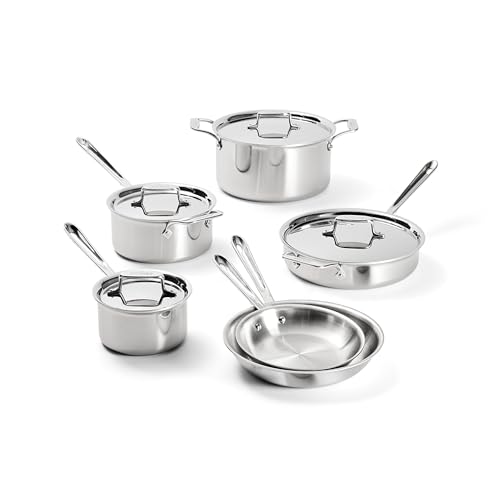 Check Price on Amazon
Before synthetic coatings were invented, humans relied on seasoned cast iron and carbon steel. The "seasoning" is simply polymerized cooking oil baked into the metal, creating a natural, renewable non-stick surface.
Lodge's classic cast iron skillets are arguably the best value in the culinary world. For under $30, you get a virtually indestructible piece of cookware. Cast iron excels at heat retention, making it perfect for deep frying, baking cornbread, or searing meats. However, it is heavy and takes a long time to heat up.
Carbon steel, such as the pans made by Made In, offers similar non-toxic benefits but is lighter and more responsive to temperature changes. It's the pan of choice in professional French kitchens. Like cast iron, it requires maintenance—you must dry it immediately and oil it after use to prevent rust—but it rewards that care with a surface that becomes darker and more non-stick with every use.
Choosing the best non-toxic cookware comes down to your cooking style and maintenance tolerance.
If you prioritize convenience and easy cleanup, and are willing to replace your pans every few years, a ceramic set like Caraway or GreenPan is the right choice. Just treat them gently.
If you want a "buy it for life" solution and don't mind learning proper temperature control, the All-Clad D5 Stainless Steel set is unmatched. Pair it with a single Lodge Cast Iron skillet for your high-heat searing, and you'll have the ultimate, 100% safe, high-performance kitchen arsenal.
Ditching forever chemicals is the easiest way to make your kitchen safer. We recommend starting with a high-quality stainless steel foundation and adding ceramic only for delicate tasks like eggs.
"The transition to non-toxic cookware takes a slight mindset shift, but the peace of mind—and the vastly superior cooking performance of materials like clad stainless and cast iron—is worth every penny."
— Marcus Webb, Senior Kitchen Editor