Best Chef’s Knives for Home Cooks (2026)
Six verified picks at every budget: the MAC MTH-80 for most cooks, the Victorinox Fibrox Pro for value, a forged Wüsthof Classic, the budget-forged Mercer Genesis, a Damascus Shun Classic, and the featherweight Global G-2.
A chef’s knife does about 80% of the cutting in a home kitchen, so it is the one knife worth getting right. The good news: you do not need a block set or a $300 blade. The knives below cover every budget from about $40 to under $200, and each one has a clear reason to exist.
This October 2026 update rebuilds the guide around published testing from Wirecutter, America’s Test Kitchen, and Serious Eats, plus maker specs for steel, hardness, edge angle, and weight. We rechecked every Amazon listing by product title and model number on October 14, 2026, and fixed two links: the MAC now points to the correct MTH-80 Professional listing, and the Shun Classic now goes to its product page instead of a search.
Round out your kit with a paring knife, a knife-friendly cutting board, and a good knife sharpener. More knife coverage lives in our Knives hub and the site-wide Best Picks.
How We Chose These Chef’s Knives
We looked for an 8-inch blade that arrives sharp and stays that way, a handle that is secure when wet, good knuckle clearance, sensible weight and balance, and steel that a home cook can realistically maintain. We cross-checked long-running test results from Wirecutter, America’s Test Kitchen, and Serious Eats, read maker specs for steel, hardness (HRC), edge angle, and weight, and confirmed each US Amazon listing by product title and model number (never guessed). Scores are our editorial ratings based on that research, not lab measurements. Prices move, so always check the live listing.
Jump to: MAC MTH-80 · Victorinox Fibrox Pro · Wüsthof Classic · Mercer Genesis · Shun Classic · Global G-2 · Comparison · Keep It Sharp · Buying Guide · FAQ
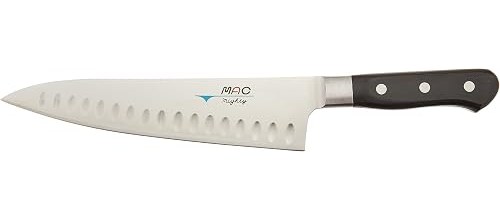
MAC Professional 8-Inch Chef’s Knife with Dimples (MTH-80)
A Japanese–Western hybrid: thin 2.5 mm blade, hard steel that holds its edge, a bolster, and a Pakkawood handle that feels familiar from day one.
| Spec | Detail |
|---|---|
| Our score | 9.4 / 10 |
| Price | ~$160 on Amazon at our check; MAC lists $195 |
| Blade | 7.88 in, 2.5 mm thick, 1.88 in tall, dimpled (hollow-edge) |
| Steel | MAC high-carbon molybdenum stainless; ~59–61 HRC per retailers |
| Edge angle | About 15° per side |
| Construction | Bolstered, full-length tang, Pakkawood handle |
| Weight | 6.5 oz (MAC spec) |
| Made | Japan |
| Care | Hand wash only; not dishwasher safe |
| ASIN | B000N5H2XU |
Wirecutter has named the MAC MTH-80 its top chef’s knife pick since 2013, and Forbes Vetted calls MAC’s Professional chef’s knife its best overall. The reason shows up on the cutting board: the blade is thin enough to glide through onions and carrots without wedging, yet the bolster and Western handle give the planted, secure grip that German-knife owners expect.
The dimples along the blade cut down on potato and apple slices sticking to the steel, and the harder steel stays keen noticeably longer than the Victorinox or Wüsthof between sharpenings. The trade-off is that hard, thin steel chips rather than rolls if you twist it in squash, hack through bone, or cut frozen food. Use a wood or plastic board and a 15° sharpener or whetstone.
Buying note: MAC also sells a cheaper “Chef Series” 8-inch hollow-edge knife (TH-80, about $115) with no bolster and a slightly different blade. It is a good knife, but it is not the MTH-80. Our link goes to the Professional MTH-80 listing; we fixed an older link on this page that pointed to the TH-80.
- Best balance of sharpness, edge retention, and comfort in this guide
- Thin blade glides through dense produce without wedging
- Bolster and Western handle feel secure in a pinch grip
- Dimples reduce sticking on potatoes, apples, and squash
- Hand wash only
- Harder steel can chip on bones, frozen food, or twisting cuts
- About three times the Victorinox price
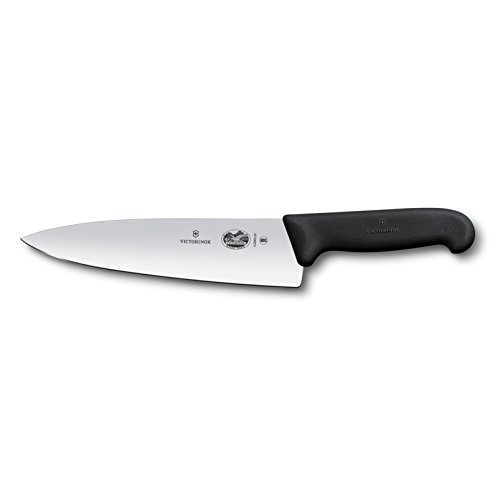
Victorinox Fibrox Pro 8-Inch Chef’s Knife
The stamped Swiss workhorse you find in culinary schools and restaurant prep lines: light, sharp, easy to resharpen, and forgiving.
| Spec | Detail |
|---|---|
| Our score | 9.2 / 10 |
| Price | ~$50 on Amazon at our check |
| Blade | 8 in, stamped, plain edge |
| Steel | High-carbon stainless (X50CrMoV15-type), ~56 HRC |
| Edge angle | About 15°–20° per side |
| Construction | Stamped, no bolster, full-height heel for sharpening |
| Handle | Textured Fibrox (TPE), NSF certified |
| Weight | About 6 oz |
| Made | Switzerland |
| Care | Dishwasher safe per Victorinox; hand washing recommended |
| Warranty | Lifetime against defects |
| ASIN | B000638D32 |
America’s Test Kitchen says it has routinely tested and recommended the Fibrox Pro 8-inch for nearly three decades: it cuts all kinds of food easily, stays fairly sharp, is comfortable for hands of all sizes, and is easy to sharpen. Wirecutter’s budget pick is the closely related Victorinox Swiss Classic 8-inch, which shares the blade design but uses a smoother handle.
Softer steel means the edge rolls instead of chipping, so a few strokes on a honing steel bring it right back. It also means you will hone it more often than a MAC or Shun. The plastic handle looks utilitarian and some cooks find it bulky, but nothing else this cheap is this good. Read our full Victorinox Fibrox Pro review or the head-to-head Wüsthof vs Victorinox comparison.
- Outstanding value; sharp out of the box
- Non-slip handle stays secure when wet or greasy
- Easy to hone and resharpen; forgiving steel
- Lifetime warranty; listed dishwasher safe
- Needs honing more often than harder Japanese steel
- Plain, utilitarian look and feel
- Light blade does less of the work on dense squash
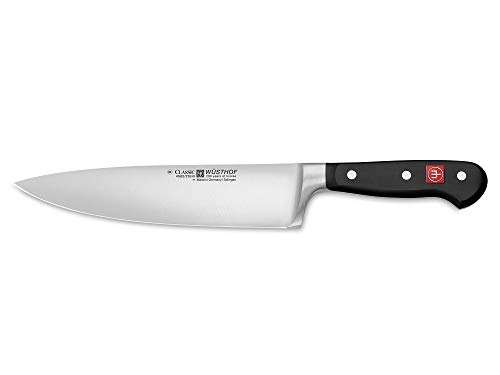
Wüsthof Classic 8-Inch Chef’s Knife (4582/20)
Forged from a single block of steel in Solingen, Germany, with a full bolster and triple-riveted handle. Heavy, solid, and built to last generations.
| Spec | Detail |
|---|---|
| Our score | 8.9 / 10 |
| Price | ~$150 on Amazon at our check |
| Blade | 8 in, plain edge |
| Steel | X50CrMoV15 high-carbon stainless, 58 HRC |
| Edge angle | 14° per side (PEtec) |
| Construction | Precision forged, full tang, full bolster, triple-riveted |
| Handle | POM synthetic |
| Weight | 8.5 oz (Wüsthof spec) |
| Made | Solingen, Germany |
| Care | Hand wash recommended |
| ASIN | B00009ZK08 |
If you picture a “real” chef’s knife, you probably picture this one. Wüsthof tempers the Classic to 58 HRC, a couple of points harder than the Victorinox, and sharpens it to 14° per side with its PEtec process, so it arrives sharper and holds its edge a bit longer than most German knives.
At about 8.5 ounces, it lets weight do the work through sweet potatoes and winter squash, and the full bolster protects your fingers. The same bolster is the main downside: over years of sharpening, it gets in the way at the heel, and the knife feels heavy during long prep sessions compared with the MAC. Not sure between German and Japanese? Our Japanese vs German knives guide breaks it down.
- Solid, balanced, forged feel with real heft
- Harder than most German knives; precise PEtec edge
- Full bolster protects fingers
- Lifetime warranty; huge owner base
- Heavy for long prep sessions
- Full bolster makes sharpening the heel harder over time
- Costs about three times the Fibrox
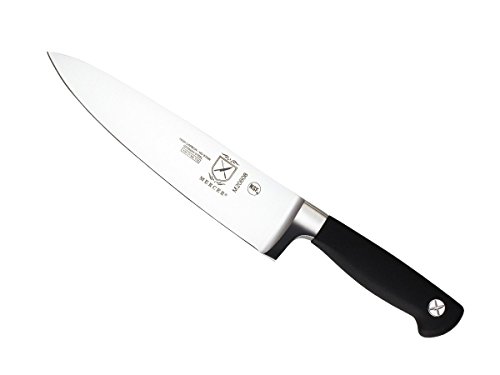
Mercer Culinary Genesis 8-Inch Chef’s Knife (M20608)
Forged high-carbon German steel and a non-slip Santoprene handle — a culinary-school favorite that feels far more expensive than it is.
| Spec | Detail |
|---|---|
| Our score | 8.6 / 10 |
| Price | ~$40 on Amazon at our check |
| Blade | 8 in, taper-ground plain edge |
| Steel | High-carbon German stainless (X50CrMoV15) |
| Construction | Precision forged, full tang, short bolster |
| Handle | Santoprene, non-slip, NSF |
| Weight | About 8.8 oz (Serious Eats measurement) |
| Made | Taiwan |
| Care | Hand wash only; not dishwasher safe |
| ASIN | B000OOQZMY |
Serious Eats tested the Genesis and wrote that this $40 knife gives knives three times its price a run for their money. Testers liked the grippy handle and the slim, gently curved blade, and found it did not dull during testing.
It is heavier than the Victorinox and closer to a Wüsthof in the hand, which is great if you like a planted knife and less great if you want something nimble. The steel is the same soft German type as the Fibrox, so plan on regular honing. The rubbery handle won’t win style points, but it stays secure with wet or greasy hands.
- Forged, full-tang build at a budget price
- Very secure Santoprene grip
- Heft helps on dense vegetables
- NSF certified for commercial kitchens
- Softer steel needs frequent honing
- Handle looks and feels utilitarian
- Heavier than the Victorinox or MAC
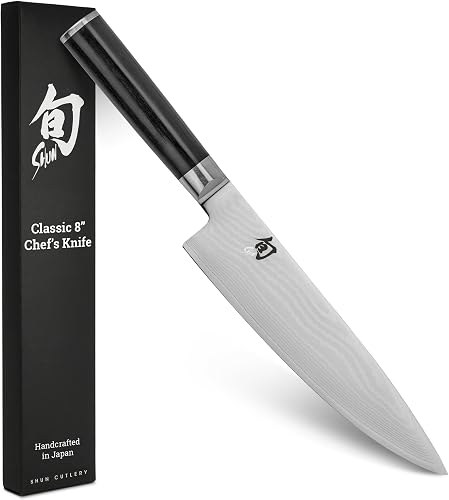
Shun Classic 8-Inch Chef’s Knife (DM0706)
Handcrafted in Seki, Japan: a VG-MAX cutting core clad in 68 layers of stainless Damascus, with a D-shaped Pakkawood handle.
| Spec | Detail |
|---|---|
| Our score | 8.7 / 10 |
| Price | ~$140 on Amazon at our check; Shun lists $189.95 |
| Blade | 8 in (203 mm), plain edge |
| Steel | VG-MAX core, 68-layer stainless Damascus cladding, ~60–61 HRC |
| Edge angle | 16° per side (Shun spec) |
| Handle | D-shaped ebony Pakkawood |
| Weight | 6.7 oz (Shun spec) |
| Made | Seki City, Japan |
| Care | Hand wash only; free sharpening from Shun |
| ASIN | B0000Y7KNQ |
Shun’s VG-MAX steel is hard and fine-grained, so the Classic takes a very keen edge and keeps it a long time. The Damascus cladding is mostly about looks and corrosion resistance, but it does make this the most striking knife here. Shun backs it with a limited lifetime warranty and free sharpening for as long as you own it.
Hardness cuts both ways: the thin tip and edge are the most likely to chip if you twist, pry, or hit bone. The D-shaped handle fits a pinch grip nicely for most people, but its angled shape suits right-handers slightly better. Note that America’s Test Kitchen’s upgrade pick is a different Shun model, the Classic 8-inch Western Cook’s Knife, which has a longer Western-shaped handle. The DM0706 linked here is the traditional Classic chef’s knife.
- Excellent edge retention from hard VG-MAX steel
- Very sharp, precise 16° edge
- Stunning Damascus finish
- Free lifetime sharpening from Shun
- Most chip-prone knife here; no bones or frozen food
- D-shaped handle favors right-handers
- Premium price for a modest performance gain over the MAC
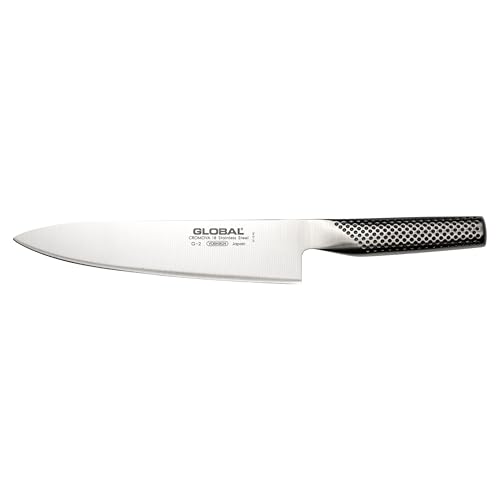
Global G-2 8-Inch Chef’s Knife
Blade and handle are one seamless piece of CROMOVA 18 stainless; the hollow handle is weighted for balance.
| Spec | Detail |
|---|---|
| Our score | 8.3 / 10 |
| Price | ~$106 on Amazon at our check |
| Blade | 8 in (20 cm), plain edge |
| Steel | CROMOVA 18 molybdenum/vanadium stainless, ~56–58 HRC |
| Edge angle | About 15° per side |
| Construction | One-piece stainless, hollow weighted handle |
| Handle | Dimpled stainless steel |
| Weight | About 5.5 oz |
| Made | Japan |
| Care | Hand wash only |
| ASIN | B00005OL44 |
Few knives look as distinctive as the G-2, and fewer still are this light. The CROMOVA 18 steel is a little softer than most Japanese knives, so it is easier to touch up at home, and the seamless construction leaves nowhere for food to hide.
The metal handle is the dealbreaker for some cooks. It is thin, and the dimples help, but it can feel slick with wet or oily hands and less substantial than a Pakkawood or plastic handle. Try one in a store if you can; people tend to love it or leave it.
- Featherlight and nimble
- Seamless, hygienic one-piece design
- Sharp, easy-to-maintain edge
- Iconic look
- Metal handle can feel slippery and thin
- Light weight does less work on dense produce
- Polarizing feel; try before you buy if possible
Chef’s Knives Compared
| Knife | Style | HRC | Edge / side | Weight | Price | Score |
|---|---|---|---|---|---|---|
| MAC MTH-80 | Japanese hybrid, bolstered | ~59–61 | ~15° | 6.5 oz | ~$160–$195 | 9.4 |
| Victorinox Fibrox Pro | Stamped Swiss | ~56 | 15°–20° | ~6 oz | ~$45–$55 | 9.2 |
| Wüsthof Classic | Forged German, full bolster | 58 | 14° | 8.5 oz | ~$150–$170 | 8.9 |
| Mercer Genesis | Forged German-style | ~56 | ~15° | ~8.8 oz | ~$40 | 8.6 |
| Shun Classic DM0706 | Japanese Damascus | ~60–61 | 16° | 6.7 oz | ~$140–$190 | 8.7 |
| Global G-2 | One-piece Japanese | ~56–58 | ~15° | ~5.5 oz | ~$105–$120 | 8.3 |
Hardness and edge angles come from maker or retailer specs; “~” marks approximate or retailer-reported figures. Mercer’s Genesis edge angle is our estimate for a German-style taper grind.
Keep It Sharp: Two Add-Ons Worth Buying
A dull $190 knife is worse than a sharp $45 one. These two tools keep any knife above cutting like new.

Wüsthof 10-Inch Honing Steel (~$65): Honing realigns the edge between sharpenings. A few light strokes before each cooking session keep German knives like the Wüsthof, Victorinox, and Mercer cutting cleanly for months.
Check Price on Amazon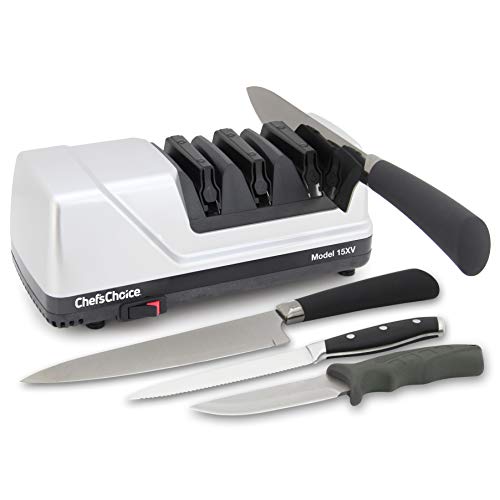
Chef’sChoice 15XV EdgeSelect Electric Sharpener (~$165): A 3-stage diamond sharpener that puts a 15° edge on both German and Japanese knives. It removes metal quickly, so use the fine stage for touch-ups. See our knife sharpener guide for whetstone and manual options.
Check Price on AmazonStore your knives on a magnetic strip, in a block, or with edge guards. Loose knives in a drawer dull quickly. See how to store knives safely.
How to Choose a Chef’s Knife
German vs Japanese. German knives (Wüsthof, Mercer, Victorinox) use softer steel around 56–58 HRC with thicker edges sharpened to roughly 14–20° per side. They are tough and forgiving, and they need honing more often. Japanese knives (Shun, Global) run harder, around 58–61 HRC, with thinner, more acute edges that stay sharp longer but can chip. The MAC MTH-80 sits in between. Our Japanese vs German knives guide goes deeper, and Wüsthof vs Victorinox compares the two most popular German-style picks head to head.
Weight and balance. Heavier knives (8–9 oz, like the Wüsthof and Mercer) power through dense squash. Lighter knives (5.5–6.5 oz, like the Global, MAC, and Victorinox) are less tiring during long prep. If you have never had a preference, start light.
Forged vs stamped. Forged knives are made from a heated, shaped bar of steel and usually have a bolster. Stamped knives are cut from sheet steel, so they are lighter and cheaper. Stamped does not mean bad; the stamped Victorinox is one of the best-tested knives in the world.
Bolster. A full bolster (Wüsthof Classic) protects your fingers but makes the heel harder to sharpen over the years. A half bolster or none (Mercer, Victorinox, MAC) lets you sharpen the full edge.
Blade length. Eight inches is the sweet spot for most home cooks and standard boards. Go to 6 inches for small hands or tiny boards, or 10 inches if you often break down big roasts or melons.
Care. Cut on wood or plastic, never glass, stone, or plates. Hand wash and dry right away, hone often, and sharpen a few times a year. Pair your knife with a good cutting board.
Frequently Asked Questions
What is the best chef’s knife for most home cooks?
Is an expensive chef’s knife worth it?
German or Japanese chef’s knife: which should I buy?
What size chef’s knife should I get?
Can I put a chef’s knife in the dishwasher?
How often should I sharpen my chef’s knife?
What’s the difference between the MAC MTH-80 and the MAC TH-80?
Final Verdict
Buy the MAC MTH-80 if you want one chef’s knife that will feel great and stay sharp for years. Get the Victorinox Fibrox Pro if you want the best knife for about $50, or the Mercer Genesis if you want forged heft for even less. Choose the Wüsthof Classic for a heavy German heirloom, the Shun Classic for Damascus beauty and edge retention, or the Global G-2 for the lightest knife here. Whatever you buy, add a honing steel; it matters more than the logo on the blade.