Disclosure: ProvenKitchenTools.com is reader-supported. When you buy through links on our site, we may earn an affiliate commission at no extra cost to you. Learn more.
🔪 Knives & CutleryFirst published early 2026Updated October 7, 2026
Wüsthof vs Victorinox: Which Chef's Knife Is Worth It in 2026?
The forged Wüsthof Classic 8″ against the stamped Victorinox Fibrox Pro 8″ — steel, weight, edge, care, and price checked October 2026 — plus the in-between options (Wüsthof Gourmet, Classic Ikon) and the two tools that keep either knife sharp.
P
ProvenKitchenTools Editorial Team
Independent kitchen gear testing & research
Ask ten cooks which chef's knife to buy and two names come up again and again: Wüsthof, the Solingen family firm whose forged Classic has been the default “serious” German knife for generations, and Victorinox, the Swiss Army Knife maker whose stamped Fibrox Pro is the workhorse of culinary schools and restaurant prep lines. They are both excellent. They are not interchangeable.
This October 2026 update re-checks both knives against the makers' current spec sheets and live US Amazon listings (ASINs verified by product title and model number on October 7, 2026), corrects our weight and spec figures, and adds the in-between models people actually cross-shop. If you are still deciding on a style, start with Japanese vs German knives; for the full field (MAC, Global, Mercer and more) see Best Chef's Knives for Home Cooks; and for the budget side in depth read our Victorinox Fibrox Pro review.
How We Compared Them (and What Changed in This Update)
Scores combine the makers' published specs (Wüsthof SKU 1040100120 / model 4582-20; Victorinox 5.2063.20), live US Amazon listing data checked October 7, 2026, and patterns in thousands of long-term owner reviews (4.8★ from 2,700+ ratings for the Classic; 4.7★ from 9,600+ for the Fibrox Pro). We do not run lab hardness tests, and prices move daily — always check the live listing.
October 2026 changes: fixed a broken Victorinox buy link that pointed to the wrong product; corrected the knives' weights to the makers' figures (Victorinox lists the Fibrox at 6.4 oz; Wüsthof-sourced figures for the Classic run about 8.5–9.5 oz); added Wüsthof's 14° per-side edge spec; re-priced both knives; and added the Wüsthof Gourmet, Classic Ikon, Victorinox Grand Maître, and sharpening gear.
2Head-to-Head Knives
6Verified /dp ASINs
58Wüsthof HRC
2026Specs & Prices Rechecked
Head to Head
Wüsthof Classic vs Victorinox Fibrox Pro: Specs Side by Side
Spec
Wüsthof Classic 8″
Victorinox Fibrox Pro 8″
Construction
Forged from one piece; full tang, full bolster
Stamped (laser-cut); no bolster
Steel
High-carbon stainless (X50CrMoV15)
High-carbon stainless
Hardness
58 HRC (Wüsthof spec)
Softer; commonly cited ~55–56 HRC (not published on product page)
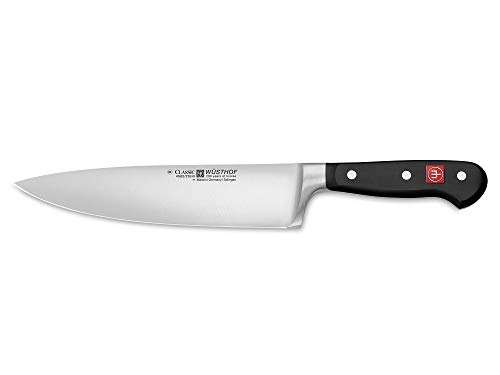
The Wüsthof Classic is forged: a single blank of steel is heated and shaped into blade, bolster, and tang, then hardened, ground, and edged. The thick bolster gives your index finger and thumb a natural resting place for a pinch grip and protects the hand from sliding onto the edge, and the full tang runs to the butt of the triple-riveted handle. The result feels dense, planted, and balanced right at the bolster.
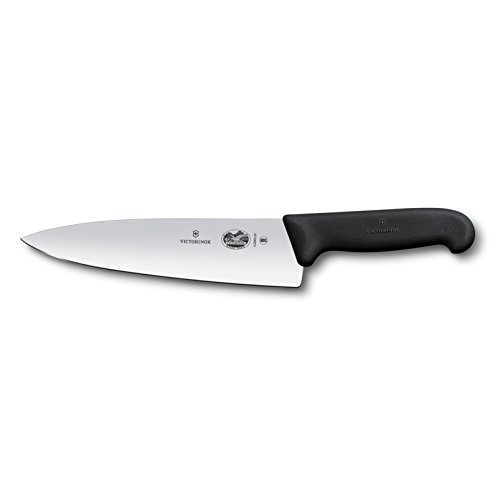
The Victorinox Fibrox Pro is stamped: laser-cut from sheet steel, then heat-treated, ground, and fitted into a molded Fibrox handle. There is no bolster, so the whole edge — heel included — reaches the board and the sharpener. That makes it lighter and much cheaper to produce, not flimsy: stamped knives today are precise, and the Fibrox has survived decades of abuse in commercial kitchens.
Practical upshot: the Wüsthof's bolster is lovely in the hand but makes the last half-inch of the heel harder to sharpen evenly over the years. The Fibrox's simpler profile is easier to keep sharp along its full length.
02 — Steel & Edge
Edge Retention and Sharpening
Both use high-carbon stainless steel of the familiar German/Swiss type — tough, stain-resistant, and forgiving. The difference is heat treatment and edge. Wüsthof hardens the Classic to 58 HRC and applies its laser-guided PEtec edge at about 14° per side; the company says PEtec blades are 20% sharper with twice the edge retention of its earlier edges (that is Wüsthof's claim, not our measurement). In everyday use the Classic simply needs touching up less often.
The Fibrox's softer steel loses its keenest bite sooner, so owners hone it more often. The trade-off works in its favor at home: a few strokes on a honing steel or a quick pass through an electric sharpener brings it right back, and a softer edge is less likely to chip if it meets a bone or a careless drawer. Neither knife is fussy the way a hard Japanese gyuto can be — see Japanese vs German knives for that trade-off.
03 — Ergonomics
Weight, Balance, and Grip
On the makers' figures the Classic is roughly 40–50% heavier (about 8.5–9.5 oz vs 6.4 oz). That heft does real work on butternut squash, sweet potatoes, and breaking down a chicken, and the balance point at the bolster makes rocking cuts feel effortless. Smaller hands and long prep sessions are where it can feel like a lot of knife.
The Fibrox's textured TPE handle is not pretty, but it is the grippiest handle at any price when your hands are wet or greasy, and the light blade is nimble for onions, herbs, and long dicing sessions. Some cooks find it a little blade-forward and wish for more weight on dense vegetables. If you can, hold both: preference here is personal, and neither is “wrong.”
04 — Care & Value
Durability, Care, and Value for Money
Victorinox lists the Fibrox as dishwasher safe; Wüsthof says to hand-wash the Classic and towel-dry it immediately. We hand-wash both — dishwashers dull edges by knocking them against racks. Store either on a magnetic strip, in a block, or with a blade guard (our knife storage guide compares the options), and cut on wood or plastic, not glass or stone (see best cutting boards).
On value, it is not close: the Fibrox delivers most of what a home cook notices for about a third of the price, and it is cheap enough to replace or to keep a second one for raw meat. The Wüsthof is a deliberate investment — you are paying for forging, finish, edge retention, and the feel of a heavier knife that, with honing and occasional sharpening, can last decades.
1
Better Knife — Our Premium Pick
Wüsthof Classic 8-Inch Chef's Knife (4582-20)
The benchmark forged German chef’s knife: 58 HRC Solingen steel, full bolster, triple-riveted handle, and a 14°-per-side PEtec edge.
👤 Best for: Cooks who want a heavier, balanced, buy-once knife that holds its edge longer and feels premium every time they pick it up
Spec
Detail
Our score
9.3 / 10
Price
$170 on Amazon (Oct 7, 2026); Wüsthof list $170
Construction
Forged, full tang, full bolster
Steel / hardness
High-carbon stainless (X50CrMoV15), 58 HRC
Edge
PEtec, ~14° per side
Weight
~8.5–9.5 oz (source-dependent)
Handle
Triple-riveted POM synthetic
Made in
Solingen, Germany
Model
4582-7/20 (Wüsthof SKU 1040100120)
ASIN
B00009ZK08
Pros
Holds a keen edge noticeably longer than the Fibrox
Planted, balanced feel; heft helps on dense vegetables
Bolster supports a proper pinch grip and protects fingers
Huge, long-running owner base (4.8★, 2,700+ ratings) and lifetime warranty
Cons
About three times the price of the Fibrox
Full bolster makes heel sharpening harder over the years
Heavier — can tire smaller hands in long sessions
Hand-wash only
Our Take
If you want one knife to own for decades, the Wüsthof Classic 8" (ASIN B00009ZK08) is still the German knife to beat. The 58 HRC steel and fine 14° edge mean it stays “tomato sharp” longer between sharpenings, and the forged bolster gives it the solid, confident feel that makes people fall in love with it.
The costs are real: price, weight, and the bolster that eventually needs a stone or a sharpener that reaches the heel. Pair it with a honing steel and it will reward you for a very long time.
Exceptional value — most of the performance for about a third of the price
Very sharp out of the box; quick to re-sharpen
Non-slip handle stays secure when wet or greasy
Light and nimble for long prep; listed dishwasher safe; lifetime warranty
Cons
Needs honing more often than the Wüsthof
Utilitarian look and feel
Light blade can feel underpowered on squash and big roasts
Third-party pricing on Amazon fluctuates — compare sellers
Our Take
The Fibrox Pro (ASIN B000638D32) remains the easiest chef’s knife recommendation we make. It arrives startlingly sharp, the handle never slips, and when the edge fades a few strokes on a steel bring it back. For most home cooks it is all the chef’s knife they will ever need.
It loses to the Wüsthof on edge retention, heft, and pride of ownership — not on getting dinner made. Read the full Victorinox Fibrox Pro review for our long-term notes.
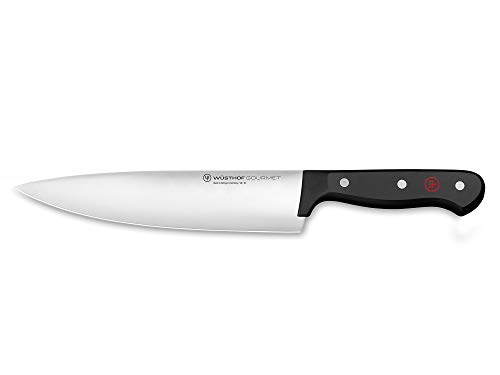
The Gourmet (model 1025044820, ASIN B0885YNPVG) looks like the Classic but is laser-cut rather than forged, so it is lighter and far cheaper — $69.98 on Amazon on October 7, 2026 against a $100 list price. You still get Solingen-made steel and a riveted synthetic handle, but not the bolster, the extra heft, or the PEtec forged edge. It is Wüsthof's direct answer to the Fibrox; we would still take the Fibrox for its grip and value, but the Gourmet is a good pick if you prefer a traditional riveted handle or are matching an existing Wüsthof set.
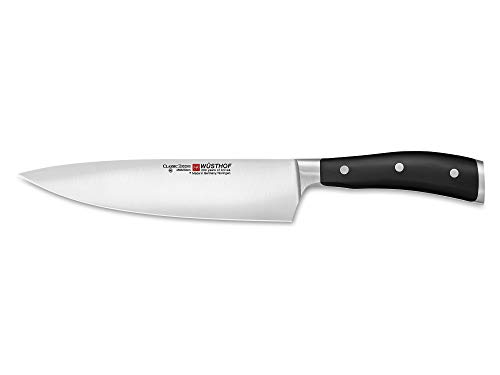
Same 58 HRC forged steel and PEtec edge as the Classic, with a contoured, more ergonomic handle and a double-bolster design (ASIN B000YMURSE, model 4596-7/20). It listed at $200 on Amazon on October 7, 2026. Choose it if the Classic's flat-sided handle feels blocky in your hand; otherwise the Classic is the better value.
Victorinox Grand Maître 8″ — forged Victorinox (not ranked)
If you like Victorinox but want forged heft, the Grand Maître (item 7.7403.20G) is the brand's forged chef's knife: made in Germany, 9.9 oz, POM handle, $155 on Victorinox's US site. We did not rank or link it because the US Amazon listing we found on October 7, 2026 had no customer reviews and a single third-party unit in stock; at that price, the Wüsthof Classic has a far longer track record.
Keep It Sharp
The Two Tools That Matter for Either Knife
A $170 knife that is never honed will lose to a $45 knife that is. Honing realigns a rolled edge in seconds; sharpening removes metal to make a new edge a few times a year. Our full breakdown lives in Best Knife Sharpeners for Home Cooks.
Wüsthof 10″ Honing Steel (ASIN B00009WDT8)
A 10-inch steel is long enough for any 8-inch chef's knife. Wüsthof's (model 3039700526) is hardened to 58 HRC to match its knives, has a loop for hanging, and carries a 4.7★ rating from 3,300+ Amazon reviews; it listed at $65 on October 7, 2026. A few light alternating strokes every couple of cooking sessions keep both the Classic and the Fibrox cutting cleanly. Note it is a grooved steel — use light pressure.
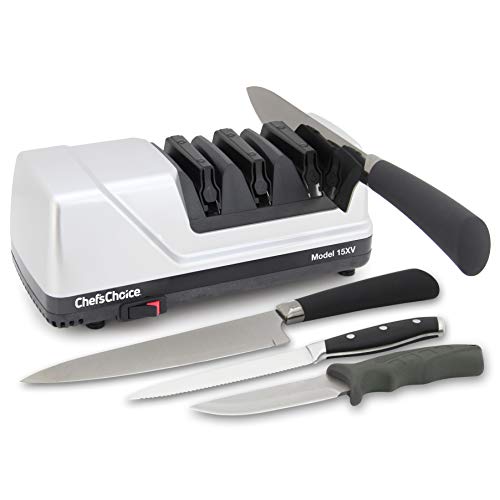
Chef'sChoice 15XV EdgeSelect Electric Sharpener (ASIN B0018RSEMU)
Our top electric pick for home cooks: diamond abrasives in three stages that convert a 20° factory edge to a 15° edge and resharpen in seconds afterward. It suits both knives here (Wüsthof's own spec is about 14° per side). It is not cheap — $135.99 as a Prime deal and $152.99 regular on October 7, 2026 — and like any electric sharpener it removes more metal than a whetstone, so use the finishing stage for touch-ups. 4.6★ from 14,000+ ratings.
This is your first good chef's knife, or you are still learning knife skills
You want something you can use hard, share with family, and not worry about
You prefer a light, nimble blade and a grippy handle
You would rather spend the difference on a honing steel, a good cutting board, and a paring knife
Buy the Wüsthof Classic if…
You cook most days and want a knife that holds its edge longer
You like a heavier, balanced, bolstered knife for a confident pinch grip
You value finish and want a buy-once knife that can last decades
You are building a matched German set over time
FAQ
Wüsthof vs Victorinox FAQs
Is Wüsthof better than Victorinox?
The Wüsthof Classic is the better-made knife: forged from one piece of steel, hardened to 58 HRC, with a full tang, full bolster, and a factory edge of about 14° per side, so it holds an edge longer and feels more solid. The Victorinox Fibrox Pro is the better value: a stamped, Swiss-made blade at roughly a third of the price that arrives very sharp, is light and grippy, and is easy to resharpen. Better knife: Wüsthof. Better deal: Victorinox.
Why is Wüsthof so much more expensive than Victorinox?
Construction and finish. The Wüsthof Classic is drop-forged in Solingen, Germany, from a single blank, heat-treated to 58 HRC, given a full bolster and full tang, and edged with Wüsthof's laser-guided PEtec process. The Victorinox Fibrox Pro is laser-cut (stamped) from sheet steel with a molded TPE handle, which is far cheaper to produce. On Amazon on October 7, 2026, the Wüsthof Classic 8" listed at $170 and the Fibrox Pro 8" at about $53 from a third-party seller (it often sells for less).
Is the Victorinox Fibrox Pro dishwasher safe?
Victorinox lists the Fibrox chef's knife as dishwasher safe, and the TPE handle tolerates it better than most. We still recommend hand-washing and drying any good knife: dishwasher cycles knock the edge against racks and other utensils and dull it faster. Wüsthof says to wash the Classic by hand and towel-dry it immediately.
Which holds an edge longer, Wüsthof Classic or Victorinox Fibrox?
The Wüsthof Classic. It is hardened to 58 HRC, while the Fibrox steel is softer (commonly cited around 55–56 HRC; Victorinox does not publish a figure on the product page). Owners typically hone the Fibrox more often between sharpenings. The flip side is that softer steel is quicker and more forgiving to bring back with a honing steel or an electric sharpener.
What weight are the Wüsthof Classic and Victorinox Fibrox 8-inch chef's knives?
Victorinox lists the Fibrox chef's knife (5.2063.20) at 6.4 oz (182 g). Wüsthof and its retailers list the Classic 8" at roughly 8.5–9.5 oz depending on the source, so it is about 40–50% heavier in the hand. The Wüsthof's weight sits at the bolster for a planted, balanced feel; the Fibrox feels nimbler and causes less fatigue during long prep sessions.
Is the Wüsthof Gourmet the same as the Wüsthof Classic?
No. The Gourmet looks similar but is laser-cut (stamped) rather than forged, so it is lighter and costs much less (about $70 on Amazon on October 7, 2026, against a $100 list price). It is still made in Solingen with a riveted synthetic handle. Think of it as Wüsthof's answer to the Fibrox: a good choice if you want the Wüsthof handle shape and brand without paying for forging.
Do I need a honing steel or a sharpener for these knives?
Ideally both. A honing steel (like the Wüsthof 10" steel) realigns a rolled edge in a few strokes and should be used every few sessions. A sharpener removes metal to create a new edge and is needed a few times a year. The Chef'sChoice 15XV electric sharpener converts edges to about 15° and works well on both knives; see our knife sharpener guide for whetstone and manual options.
Final Verdict
The Wüsthof Classic 8″ is the better knife: forged, harder, heavier, and longer-lasting at the edge — worth it if you cook a lot and want a lifetime tool. The Victorinox Fibrox Pro 8″ is the better deal and the smarter first knife for most people. Whichever you choose, add a honing steel — it matters more than the brand on the blade.