Best Nakiri Knives (2026)
Six verified picks: the Tojiro DP that Serious Eats crowns, a featherweight Global, a sub-$60 Mercer, a Damascus Shun, a MAC for MAC fans, and a forged Wüsthof.
A nakiri is the Japanese vegetable knife: a thin, rectangular blade with a dead-straight edge and no point. Because the whole edge meets the cutting board at once, it chops cleanly through onions, carrots, cabbage, and herbs without the “accordion” of half-connected slices you get from a curved blade. If you prep a lot of produce, it can quickly become the knife you reach for first.
We built this list from published testing by Serious Eats and America’s Test Kitchen plus maker specs, and we confirmed each US Amazon listing by product title and ASIN on October 28, 2026. Not sure you need a specialist? Our Best Santoku Knives guide covers the more versatile Japanese all-rounder, our Best Chef’s Knives for Home Cooks covers the rocking-style option, and our Japanese vs German knives guide explains the steel trade-offs.
Pair your nakiri with a knife-friendly cutting board and a good knife sharpener, and read how to store knives safely. More knife coverage lives in our Knives hub and the site-wide Best Picks roundup.
How We Chose These Nakiri Knives
We looked for a 6.5- to 7-inch double-bevel blade that is sharp out of the box, thin enough to avoid wedging in dense vegetables, comfortable when your hands are wet, and realistic for home cooks to maintain. We leaned on Serious Eats’ hands-on nakiri testing, checked America’s Test Kitchen’s recommendations, used maker specs for steel, hardness, and edge angle, read Amazon reviews for long-term problems like rust spots and chipping, and locked every ASIN from a live Amazon product page (never invented). Scores are our editorial ratings based on that research, not lab measurements. Prices move, so always check the live listing.
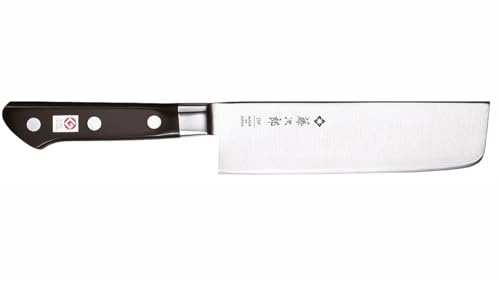
Tojiro DP 6.5-Inch (165mm) Nakiri (F-502)
The nakiri to buy if you want one: thin, hard, and seriously sharp, with a Western handle that feels familiar.
| Spec | Detail |
|---|---|
| Our score | 9.3 / 10 |
| Price | ~$120 |
| Blade | 6.5 in (165 mm), plain edge |
| Steel | VG-10-class cobalt alloy core, 3-layer stainless clad |
| Hardness | HRC 60 (per listing) |
| Edge angle | 9–12° (per listing) |
| Weight | ~6.7 oz |
| Handle | Laminated wood, bolstered Western style |
| Made | Japan |
| Care | Hand wash only |
| ASIN | B000UAUKHI |
Serious Eats tested a range of nakiri knives and named the Tojiro DP its best overall pick, scoring it near the top for out-of-box sharpness and edge retention after testing. The appeal is the steel: a hard VG-10-class core clad in softer stainless, ground thin, so it drops through onions, carrots, and cabbage with almost no wedging.
The Western handle and small bolster make it easy for anyone coming from a German chef’s knife. The trade-offs are the usual ones for hard Japanese steel: it can chip if you twist it in a squash or hit a bone, and it should never sit wet. Amazon availability sometimes runs through third-party sellers, so check that the seller is reputable before you buy.
Pros: Very sharp, thin blade that holds its edge; Familiar Western handle; Strong value for the steel quality.
Cons: Hard steel can chip if misused; Sometimes sold only by third-party sellers; Hand wash only.
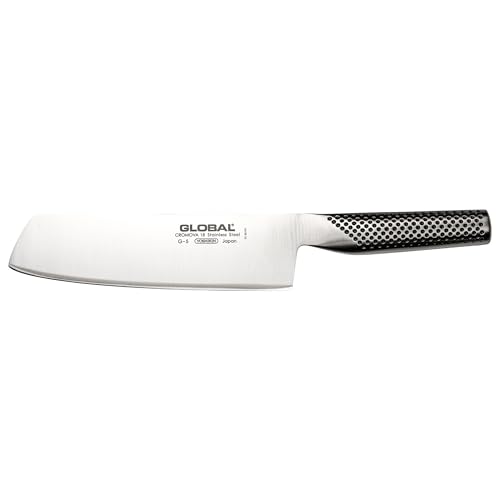
Check Price on AmazonGlobal G-5 7-Inch Vegetable Knife (Nakiri)
A sleek, featherweight nakiri that zips through herbs and soft produce.
| Spec | Detail |
|---|---|
| Our score | 9.0 / 10 |
| Price | ~$95–$150 |
| Blade | 7 in, plain edge |
| Steel | Cromova 18 stainless (molybdenum/vanadium) |
| Weight | ~6.8 oz |
| Handle | One-piece stainless with dimpled grip |
| Made | Japan |
| Warranty | Lifetime (per listing) |
| Care | Hand wash only |
| ASIN | B00005OL46 |
The Global G-5 was Serious Eats’ runner-up and a favorite among its editors. It is light and nimble, and the stamped one-piece design means no seams for food to collect in. The dimpled steel handle is easy to grip when dry and stays clean, though some cooks find it slippery with wet or oily hands.
Pricing on Amazon swings a lot: we saw it around $93 against a $149.95 list price when we checked on October 28, 2026. A handful of Amazon reviewers report small rust spots, almost always after the knife was left wet, so dry it right after washing.
Pros: Very light and agile; Seamless all-steel build is easy to clean; Frequently discounted.
Cons: Steel handle can feel slick when wet; Some rust reports if left wet; Light blade has less momentum on dense roots.
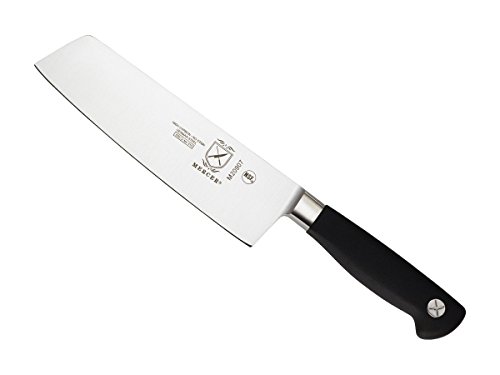
Check Price on AmazonMercer Culinary Genesis 7-Inch Nakiri (M20907)
A sturdy, forgiving nakiri that lets you try the shape without a big spend.
| Spec | Detail |
|---|---|
| Our score | 8.2 / 10 |
| Price | ~$54 |
| Blade | 7 in, plain edge |
| Steel | Forged high-carbon German stainless |
| Handle | Santoprene, non-slip |
| Made | Taiwan |
| Care | Hand wash recommended |
| ASIN | B000OOQZWY |
Mercer’s Genesis line is a culinary-school staple, and the M20907 brings the same forged German steel and soft-grip Santoprene handle to the nakiri shape. The blade is thicker and softer than the Japanese picks, so it won’t feel as razor-like on a ripe tomato, but it is far more forgiving of a hard squash or a careless drop into the sink.
Serious Eats tested it without making it a winner, which matches our read: it is a solid tool, not a standout. At about $54 sold by Amazon, with a 4.8-star average across hundreds of ratings, it is the safest way to find out whether you like a nakiri before you spend more.
Pros: Low price; Grippy handle stays secure when wet; Tough steel resists chipping.
Cons: Thicker blade wedges more in dense vegetables; Needs honing more often than Japanese steel; Less refined fit and finish.
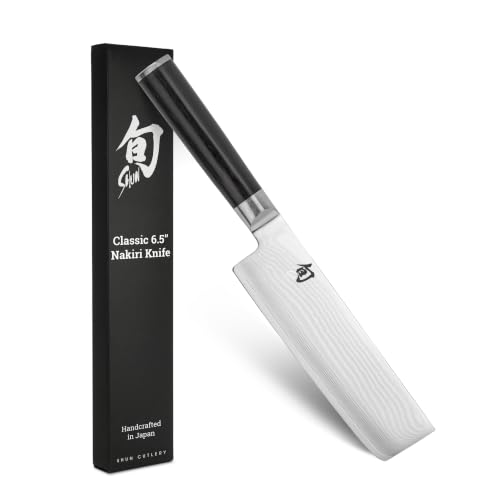
Check Price on AmazonShun Classic 6.5-Inch Nakiri (DM0728)
The good-looking, very sharp nakiri that also makes a great gift.
| Spec | Detail |
|---|---|
| Our score | 8.9 / 10 |
| Price | ~$180–$190 |
| Blade | 6.5 in, plain edge, 16° per side |
| Steel | VG-MAX core, 68-layer Damascus cladding |
| Handle | D-shaped Pakkawood |
| Made | Japan |
| Service | Free sharpening and honing from Shun |
| Care | Hand wash only |
| ASIN | B000FR2YWK |
Shun’s Classic nakiri is one of the most popular on Amazon, with a 4.8-star average across more than 1,000 ratings when we checked. The VG-MAX core takes a very keen 16° edge, and the Damascus cladding is as much about looks as performance. The D-shaped Pakkawood handle locks into your grip and works for either hand.
You pay for the finish: it costs about $60 more than the Tojiro, which cuts just as well. Like other hard Japanese blades it can chip if you twist through frozen food or bone, and the handle runs slim for large hands. Shun’s free sharpening offsets some of that cost over time.
Pros: Very sharp 16° edge; Striking Damascus finish; Free sharpening service.
Cons: Pricey for the performance; Can chip if misused; Slim handle for large hands.
Check Price on AmazonMAC Professional 6.5-Inch Nakiri (MJU-65)
A sturdier Japanese nakiri for cooks who already love MAC.
| Spec | Detail |
|---|---|
| Our score | 8.7 / 10 |
| Price | ~$150 |
| Blade | 6.5 in, plain edge |
| Steel | Molybdenum alloy steel |
| Handle | Pakkawood, bolstered |
| Made | Japan |
| Care | Hand wash only |
| ASIN | B087SWH8TQ |
MAC’s Professional line is the same series as the MSK-65 santoku and MTH-80 chef’s knife we already recommend, and this nakiri brings that thin, keen grind to a flat vegetable blade. It feels more substantial than the Global, which some cooks prefer for dense roots and cabbage.
Be aware that the US Amazon listing has only a couple dozen ratings (4.6 stars when we checked on October 28, 2026), so there is less long-term owner feedback than for the Shun or Global. Serious Eats tested a MAC vegetable cleaver from the Pro series and found it sharp but not a winner. We rank it here for cooks who want to match an existing MAC kit.
Pros: Thin, sharp MAC grind; Comfortable bolstered handle; Matches MAC santoku and chef’s knives.
Cons: Few Amazon ratings so far; Pricier than the Tojiro; Hand wash only.
Check Price on AmazonWüsthof Classic 7-Inch Hollow Edge Nakiri (4193-7)
A heavy, durable nakiri for cooks who prefer German steel.

| Spec | Detail |
|---|---|
| Our score | 8.4 / 10 |
| Price | ~$170 |
| Blade | 7 in, hollow (dimpled) edge, 10° per listing |
| Steel | High-carbon stainless, 58 HRC |
| Construction | Forged, full tang, full bolster |
| Handle | Triple-riveted synthetic |
| Made | Germany |
| Care | Hand wash recommended |
| ASIN | B002NXNFZO |
Wüsthof forges this nakiri from one piece of high-carbon stainless steel at 58 HRC and puts a thin 10° edge on it, so it is sharper than you might expect from a German knife. It has a 4.8-star average across hundreds of Amazon ratings, and the heft helps it power through squash and sweet potatoes.
Serious Eats found the hollow-edge indents caught slightly on dense sweet potato slices, and the full bolster makes the heel harder to sharpen over the years. At about $170 it costs more than the Tojiro, which is sharper. Buy it to match your set or if you simply prefer softer, tougher steel. Our Japanese vs German knives guide explains the trade-off.
Pros: Tough, chip-resistant steel; Surprisingly keen 10° edge; Matches Wüsthof Classic sets.
Cons: Heavy for a vegetable knife; Dimples can catch on dense vegetables; Full bolster complicates sharpening.
Check Price on AmazonNakiri Knives Compared
| Knife | Blade | Edge | Build | Hardness | Price |
|---|---|---|---|---|---|
| Tojiro DP F-502 | 6.5 in | Plain | VG-10-class core, laminated wood handle | 60 HRC | ~$120 |
| Global G-5 | 7 in | Plain | One-piece stainless | Not published | ~$95–$150 |
| Mercer Genesis M20907 | 7 in | Plain | Forged, Santoprene | Not published | ~$54 |
| Shun Classic DM0728 | 6.5 in | Plain, 16° | Damascus clad, D-handle | VG-MAX (not published) | ~$180–$190 |
| MAC Professional MJU-65 | 6.5 in | Plain | Bolstered, Pakkawood | Not published | ~$150 |
| Wüsthof Classic 4193-7 | 7 in | Hollow, 10° | Forged, full bolster | 58 HRC | ~$170 |
Nakiri vs Santoku vs Usuba
Nakiri: a double-bevel, flat-edged vegetable knife for home cooks. Chop straight down or push forward; don’t rock it. Santoku: a slightly curved blade with a blunt tip that handles vegetables plus boneless meat and fish, which makes it the better single-knife choice (see our santoku picks). Usuba: the professional single-bevel cousin of the nakiri, used for paper-thin decorative cuts; it is handed and needs whetstone sharpening, so most home cooks are better served by a nakiri.
Also considered: the Yoshihiro VG-10 16-layer hammered Damascus nakiri measured as the sharpest knife in Serious Eats’ testing, but it was listed as currently unavailable on Amazon when we checked, so we left it out of the rankings.
Keep it sharp: hone before use with a steel such as the Wüsthof honing steel, and sharpen a few times a year. The Chef’sChoice 15XV electric sharpener puts a 15° edge on most double-bevel nakiri. See our sharpener guide for whetstone and manual options.
Frequently Asked Questions
What is the best nakiri knife for most people?
What is a nakiri knife used for?
Nakiri vs santoku: which should I buy?
Is a nakiri the same as a vegetable cleaver?
Can nakiri knives go in the dishwasher?
What angle should I sharpen a nakiri at?
Are nakiri knives good for left-handed cooks?
Final Verdict
Buy the Tojiro DP F-502 if you want one excellent nakiri at a fair price. Choose the Global G-5 for the lightest, nimblest blade, or the Mercer Genesis to try the shape for about $54. Spend up on the Shun Classic for Damascus looks and free sharpening, pick the MAC Professional to match a MAC kit, or go with the Wüsthof Classic if you prefer tough German steel.