Best Santoku Knives (2026)
Six verified picks: the MAC Professional most testers crown, a sub-$100 MAC, a tough Victorinox for a budget, the test-kitchen-winning Misono, a Damascus Shun, and a forged Wüsthof.
A santoku is the Japanese answer to the chef’s knife: a shorter, taller blade with a flatter edge and a rounded “sheep’s foot” tip. That shape is built for push-cutting (chopping straight down and forward) rather than rocking, which makes it a favorite for onions, carrots, herbs, cabbage, and boneless proteins. If you find an 8-inch chef’s knife a bit long or unwieldy, a 6.5- to 7-inch santoku is often the knife that clicks.
We built this list from published testing by America’s Test Kitchen, Serious Eats, and Bon Appétit plus maker specs, and we confirmed each US Amazon listing by product title and ASIN on October 23, 2026. Still deciding on a style? Our Japanese vs German knives guide explains the steel and edge trade-offs, and our Best Chef’s Knives for Home Cooks covers the rocking-style alternative.
Round out your kit with a paring knife, a knife-friendly cutting board, and a good knife sharpener, then read how to store knives safely. More knife coverage lives in our Knives hub and the site-wide Best Picks roundup.
How We Chose These Santoku Knives
We looked for a 6.5- to 7-inch blade that is sharp out of the box, a flat enough edge for clean push-cuts, a handle that stays secure when wet, and steel that is realistic for home cooks to maintain. We cross-checked results from America’s Test Kitchen, Serious Eats, and Bon Appétit, used maker specs for steel, hardness, and edge angle, read Amazon reviews for long-term problems like rust spots and chipping, and locked every ASIN from a live Amazon product title (never invented). Scores are our editorial ratings based on that research, not lab measurements. Prices move, so always check the live listing.
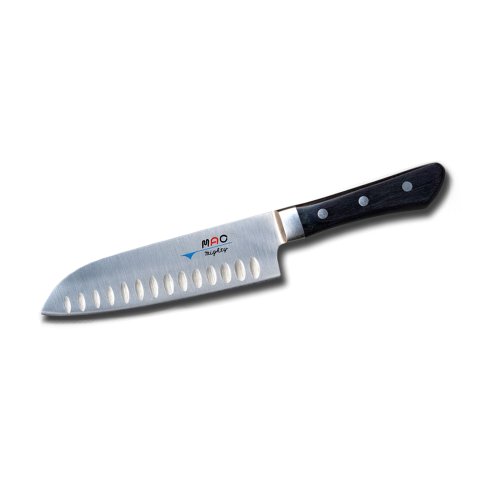
MAC Professional 6.5-Inch Hollow Edge Santoku (MSK-65)
The santoku most testers land on: razor-sharp out of the box, light, and easy to steer through onions, herbs, and chicken.
| Spec | Detail |
|---|---|
| Our score | 9.4 / 10 |
| Price | ~$140 |
| Blade | 6.5 in, hollow (dimpled) edge |
| Thickness | 2.5 mm (per Amazon listing) |
| Steel | Sub-zero tempered alloy steel |
| Construction | Bolstered, Pakkawood (resin-wood) handle |
| Made | Japan |
| Care | Hand wash only; not dishwasher safe |
| ASIN | B000N5BV5K |
Serious Eats tested 19 santokus for its guide (updated June 2026), and the MAC Professional MSK-65 came out on top. Bon Appétit also picks it as its best Western-style santoku. The appeal is simple: a thin, very sharp blade that glides through soft produce without crushing it, and dimples along the edge that help sliced potatoes and cucumbers fall away.
Unlike many Japanese knives, the MAC uses a familiar Western handle with a bolster, so it feels natural if you are coming from a German knife. It is the Santoku-shaped sibling of the MAC MTH-80 chef’s knife we already recommend. Some testers find the handle a little blocky, and like any hard Japanese steel it can chip if you pry, twist, or chop through bone.
Pros: Very sharp, thin blade that holds its edge; Dimples reduce sticking on starchy vegetables; Comfortable Western handle and bolster feel familiar.
Cons: About $140, double our value pick; Hard steel can chip if misused; Hand wash only.
Check Price on AmazonMAC Superior 6.5-Inch Santoku (SK-65)
A featherweight, 2 mm Japanese blade that slices like a much pricier knife. Just dry it right away.

| Spec | Detail |
|---|---|
| Our score | 9.2 / 10 |
| Price | ~$85 |
| Blade | 6.5 in, plain edge (no dimples) |
| Thickness | 2.0 mm |
| Steel | High-carbon steel (per Amazon listing) |
| Construction | No bolster, Pakkawood handle |
| Made | Japan |
| Care | Hand wash only; dry immediately |
| ASIN | B0006MM4RE |
America’s Test Kitchen recommends this MAC alongside its winning Misono, at well under half the price, and Bon Appétit names it its best budget santoku. At 2 mm the blade is thinner than the Professional’s, which makes it superb on tomatoes, onions, and herbs and surprisingly good on boneless meat.
Two things to know before you buy. First, the steel is stain-resistant, not stain-proof: a meaningful number of Amazon reviewers report small rust spots when it is left wet in a sink, so wash and dry it after use. Second, there is no bolster or dimples, which keeps the price down and makes the full edge easy to sharpen, but starchy slices cling a bit more than on the MSK-65.
Pros: Excellent sharpness for the price; Very light and thin, great for fine vegetable work; No bolster, so it is easy to sharpen edge-to-heel.
Cons: Can spot or discolor if left wet; No dimples, so food sticks more; Very thin blade is less forgiving on hard squash.
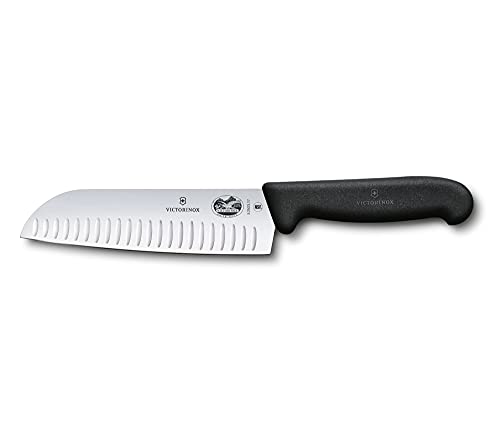
Check Price on AmazonVictorinox Fibrox Pro 7-Inch Granton Santoku
A cheap, grippy, low-maintenance santoku that won’t punish you for a little neglect.
| Spec | Detail |
|---|---|
| Our score | 8.6 / 10 |
| Price | ~$45–$60 (varies by seller) |
| Blade | 6.7 in per Victorinox (sold as 7 in), Granton (scalloped) edge |
| Construction | Stamped stainless steel |
| Handle | Fibrox (textured TPE), non-slip when wet |
| Made | Switzerland |
| Care | Hand wash recommended |
| Warranty | Lifetime against defects |
| ASIN | B089734T2G |
The Victorinox Fibrox Pro 8-inch chef’s knife has been a budget favorite of testers for years, and this santoku uses the same stamped Swiss steel and textured Fibrox handle. You get a sharp out-of-box edge, Granton scallops to help sliced potatoes release, and a handle that stays put when your hands are wet or greasy.
It is softer and thicker than the Japanese picks, so it needs honing more often and won’t feel as laser-like on a ripe tomato. In exchange it is far more forgiving of bumps, twists, and the occasional hard squash. If you already own the Victorinox chef’s knife, see our Wüsthof vs Victorinox comparison for how this line stacks up against forged German steel.
Pros: Low price with a reliable, sharp edge; Non-slip handle is safe and comfortable; Tough, forgiving steel and lifetime warranty.
Cons: Stamped blade feels light and utilitarian; Needs honing more often than Japanese steel; Amazon pricing jumps around between sellers.
Check Price on AmazonMisono UX10 7-Inch Santoku (Right-Handed)
The test-kitchen winner for cooks who want the sharpest, most refined santoku and will treat it well.
| Spec | Detail |
|---|---|
| Our score | 9.3 / 10 |
| Price | ~$200–$210 |
| Blade | 7.0 in (18 cm), plain edge |
| Steel | Swedish stain-resistant steel, HRC 59–60 |
| Edge | Asymmetric bevel, sold in right-hand (this listing) and left-hand versions |
| Construction | Slanted nickel-silver bolster |
| Made | Japan |
| Care | Hand wash only |
| ASIN | B000XSZ7SE |
America’s Test Kitchen named the Misono UX10 its top santoku. The blade is Swedish stain-resistant steel hardened to HRC 59–60, so it takes and keeps a very fine edge, and it weighs only about 6 ounces. A slanted nickel-silver bolster balances the light blade against the handle.
Know the caveats. This listing is the right-handed version because the edge is ground asymmetrically; left-handed cooks need the left-hand model. The thin tip is delicate, and stock is thin (the listing showed only a few units left when we checked on October 23, 2026). If that feels like a lot of knife, the MAC Professional gets you most of the way for about $70 less.
Pros: Superb steel and balance; Very fine, long-lasting edge; Distinctive, heirloom-quality finish.
Cons: About $200 and often low stock; Right- or left-hand specific; Delicate tip that dislikes hard foods and bones.
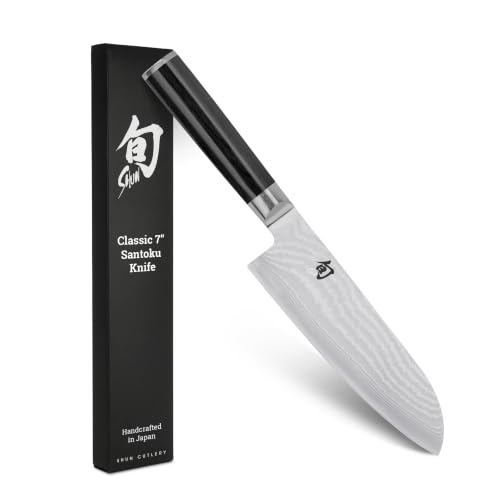
Check Price on AmazonShun Classic 7-Inch Santoku (DM0702)
The looker of the group: handcrafted in Japan, very sharp, and backed by Shun’s free sharpening service.
| Spec | Detail |
|---|---|
| Our score | 8.9 / 10 |
| Price | ~$125–$140 |
| Blade | 7 in, plain edge |
| Steel | VG-MAX core, 68-layer Damascus stainless cladding |
| Edge angle | 16° per side |
| Handle | D-shaped Pakkawood (ambidextrous) |
| Made | Japan (handcrafted) |
| Care | Hand wash only; free sharpening and honing from Shun |
| ASIN | B0000Y7KFO |
Shun builds the Classic santoku around a VG-MAX steel core wrapped in 68 layers of Damascus cladding, with a 16-degree edge and a D-shaped Pakkawood handle that works for both left and right hands. It has a 4.8-star average from about 1,500 Amazon ratings, and reviewers consistently praise its sharpness and balance. Shun also offers free sharpening and honing, a real perk for cooks who don’t sharpen at home.
The downsides are practical. There is no hollow edge, so wet slices like cucumber stick, and several reviewers report small chips after a year or so, which fits a hard, thin blade used on bone or frozen food. Shun’s care guidance warns against both and to use a soft wood board such as one from our cutting board guide.
Pros: Gorgeous Damascus finish; Very sharp 16° edge out of the box; Free sharpening service and works for left- or right-handers.
Cons: Food sticks without a hollow edge; Hard steel can chip if misused; D-shaped handle doesn’t suit every grip.
Check Price on AmazonWüsthof Classic 7-Inch Hollow Edge Santoku (4183-7)
A heavier, tougher santoku for cooks who want German durability in a flatter, push-cut shape.

| Spec | Detail |
|---|---|
| Our score | 8.7 / 10 |
| Price | ~$170 |
| Blade | 7 in, hollow (Granton-style) edge |
| Steel | High-carbon stainless, 58 HRC |
| Edge | PEtec (precision edge technology) |
| Construction | Forged, full tang, full bolster, triple-riveted |
| Made | Solingen, Germany |
| Care | Hand wash recommended |
| ASIN | B003K3ZD9M |
Wüsthof forges this santoku from one piece of high-carbon stainless steel hardened to 58 HRC, with a full tang, a full bolster, and its PEtec laser-guided edge. It is noticeably heavier than the Japanese picks, which helps it power through dense squash and root vegetables, and the hollow-edge grooves keep thin slices from clinging.
The softer steel takes honing well and resists chipping, but it won’t stay as keen as the MAC or Misono, and the full bolster makes it harder to sharpen the heel over time. You also pay a premium for the name: at about $170 it costs twice the MAC Superior. It makes most sense if you want it to match a Wüsthof Classic chef’s knife or prefer a solid, weighty feel. Our Japanese vs German knives guide explains the trade-off in detail.
Pros: Forged, full-tang durability; Heft helps on hard vegetables; Hollow edge reduces sticking.
Cons: Heavier and less sharp than Japanese picks; Full bolster complicates sharpening; Pricey for what you get.
Check Price on AmazonSantoku Knives Compared
| Knife | Blade | Edge | Build | Hardness | Price |
|---|---|---|---|---|---|
| MAC Professional MSK-65 | 6.5 in | Dimpled | Bolstered, Pakkawood | Not published (sub-zero tempered) | ~$140 |
| MAC Superior SK-65 | 6.5 in | Plain | No bolster, Pakkawood | Not published | ~$85 |
| Victorinox Fibrox Pro | 7 in | Granton | Stamped, Fibrox | Not published | ~$45–$60 |
| Misono UX10 | 7 in | Plain, asymmetric | Nickel-silver bolster | 59–60 HRC | ~$200–$210 |
| Shun Classic DM0702 | 7 in | Plain, 16° | Damascus clad, D-handle | VG-MAX (not published) | ~$125–$140 |
| Wüsthof Classic 4183-7 | 7 in | Hollow | Forged, full bolster | 58 HRC | ~$170 |
Santoku vs Chef’s Knife vs Nakiri
Santoku: 6.5 to 7 inches, flat-ish edge, blunt tip. Best for push-cutting and slicing vegetables, boneless meat, and fish; less suited to rocking cuts or fine tip work. Chef’s knife (or gyuto): 8 inches or more with a curved belly and pointed tip, so it rocks through herbs and garlic and handles bigger jobs like carving a chicken. Nakiri: a rectangular, completely flat vegetable blade with no point at all; superb for up-and-down chopping but a specialist (see our best nakiri knives). If you only own one knife, a santoku or a chef’s knife will both serve you well. Choose by how you cut, not by which is “better.”
Keep it sharp: hone before use with a steel such as the Wüsthof honing steel, and sharpen a few times a year. The Chef’sChoice 15XV electric sharpener puts a 15° edge on both Japanese and German santokus. See our sharpener guide for whetstone and manual options.
Frequently Asked Questions
What is the best santoku knife for most people?
Is a santoku better than a chef’s knife?
What size santoku should I buy?
Do the dimples (hollow or Granton edge) on a santoku help?
Can santoku knives go in the dishwasher?
What angle should I sharpen a santoku at?
Are there left-handed santoku knives?
Final Verdict
Buy the MAC Professional MSK-65 if you want one excellent santoku that most testers agree on. Get the MAC Superior SK-65 for nearly the same sharpness under $100, or the Victorinox Fibrox Pro if you want a tough, cheap knife that forgives neglect. Splurge on the Misono UX10 for the most refined edge, pick the Shun Classic for Damascus looks and free sharpening, or choose the Wüsthof Classic for German heft that matches your set.